
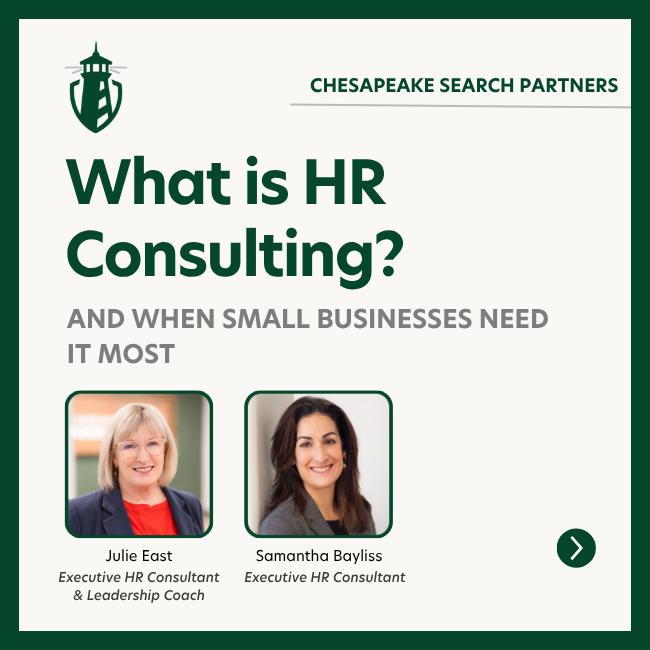
By Samantha Bayliss, Executive HR Consultant, and Julie East, Executive HR Consultant & Leadership Coach – Chesapeake HR Solutions
When Informal People Practices Stop Working
Many small businesses begin with informal approaches to managing people. Leaders hire individuals they trust, handle employee issues as they arise, and build culture organically through shared values and daily interactions.
As organizations grow, however, those informal practices often begin to strain under greater complexity. Questions around compliance, performance management, compensation structures, and leadership development become harder to answer without dedicated expertise. SHRM notes that organizations often outsource HR functions to access specialized expertise, strengthen compliance, and free internal leaders to focus on more strategic priorities.
As HR challenges become more frequent and complex, many leaders turn to HR consulting as a solution because they need a strategic partner to help them navigate people decisions that impact culture, risk, and long-term growth.
What HR Consulting Means in Practice
At its core, HR consulting provides strategic and operational guidance that helps organizations build strong, compliant, and forward-thinking people practices.
HR consultants may support organizations in areas such as:
- Employee relations and workplace issues
- HR compliance and regulatory requirements
- Compensation and benefits strategy
- Performance management systems
- Leadership development and organizational design
- HR policies and workplace practices
- Talent strategy aligned with business goals
In practice, HR consulting is rarely just about documentation or policies. More often, it means working closely with leadership teams to translate their commitment to people into scalable systems and thoughtful decision-making.
In our work across nonprofits, small businesses, start-ups, and private equity-backed organizations, we often see leaders who deeply value their people but need a trusted advisor to help turn those values into clear structures and consistent processes.
When Small Businesses Realize They Need HR Support
There is often a clear inflection point when organizations recognize they need HR expertise.
Early-stage companies frequently rely on informal processes:
- Hiring decisions are made quickly
- Performance conversations happen organically
- Policies exist more in practice than on paper
As teams grow, however, complexity increases. Leaders begin encountering challenges such as:
- Managing employee relations concerns
- Navigating compliance requirements across states
- Creating consistent performance expectations
- Structuring roles and responsibilities as teams expand
- Maintaining culture while scaling the organization
At this stage, many leaders are not necessarily looking to build a full HR department. Instead, they are seeking experienced guidance to help them make informed decisions about their people and organization.
What Is Fractional HR Leadership?
One approach that has become increasingly common for growing organizations is fractional HR leadership.
Fractional HR support embeds an experienced HR leader into the organization on an ongoing, part-time basis. This model allows companies to benefit from senior-level HR expertise without the cost and commitment of hiring a full-time HR executive.
Key advantages of fractional HR support include:
- Access to experienced HR leadership
- Strategic guidance for leadership teams
- Cost-effective HR expertise
- Consistent partnership with company leadership
- Scalable support as the organization grows
Because fractional HR leaders work within the organization regularly, they gain a deeper understanding of the company’s culture, priorities, and operational challenges. This approach allows organizations to gain experienced HR leadership while building the systems and leadership practices needed to support continued growth.
The Value of an HR Thought Partner
HR consulting conversations often begin with complex leadership questions rather than technical HR issues.
Leaders frequently ask questions such as:
- How do we restructure parts of the organization without destabilizing our culture?
- How do we address performance issues before they become larger liabilities?
- How do we scale leadership capability alongside revenue growth?
- How do we maintain compliance while preserving the mission and momentum of the organization?
There are rarely simple answers to these HR questions. In many cases, they reflect broader leadership decisions that require both strong business judgment and a thoughtful approach to people strategy.
An experienced HR consultant helps organizations:
- Work through complex decisions in real time
- Reduce reactive people decisions
- Strengthen leadership and management practices
- Address issues before they become organizational risks
- Align people strategy with broader business goals
Building HR Systems That Support Growth
As organizations expand, a strong HR infrastructure becomes increasingly important. HR consulting helps leaders establish systems that allow a business to scale while maintaining structure and clarity.
This may include:
- Developing clear HR policies and compliance frameworks
- Implementing consistent performance management practices
- Creating leadership development strategies
- Aligning compensation structures with retention goals
- Designing hiring and talent strategies that support growth
When these systems are thoughtfully built, organizations are better positioned to grow sustainably while preserving the culture and mission that made them successful in the first place.
Key Takeaway
HR consulting helps small businesses translate their commitment to people into systems, processes, and leadership practices that support long-term growth.
For many organizations, fractional HR leadership provides a practical way to access experienced guidance while maintaining the flexibility growing businesses often need.
If your organization is navigating growth, leadership transitions, or evolving HR challenges, the right HR strategy can make a meaningful difference.
Let’s Start the Conversation
At Chesapeake HR Solutions, we partner with small businesses to turn evolving people challenges into clear, scalable strategies that support growth, strengthen leadership, and reduce risk. If your team is reaching a point where informal practices no longer scale, contact us for guidance.
